
|
|
|
|
|
|
|
|
|
|
|
|
|
|
|
|
|
|
|
|
|
WALLAP is a powerful, fast and user-friendly program for analysing the stability of cantilevered and propped retaining walls. WALLAP is suitable for the analysis of both temporary works, such as sheet pile walls, and permanent works such as reinforced concrete diaphragm walls and contiguous bored pile walls.
Factors of safety are computed according to standard codes of practice while wall displacements and bending moments are calculated by a finite element analysis which models the actual sequence of construction of the wall. Earth pressures are calculated automatically from basic soil properties.
The strata profile consists of up to 100 soil types with hydrostatic or non-linear water pressure distributions. Surcharges may be applied and removed while struts and anchors may be installed and removed. The program is menu driven with context sensitive Help and on-line access to the comprehensive User Manual giving detailed guidance on data input and interpretation of results.
Methods of Analysis ( Top )
WALLAP offers two
separate types of analysis within the one program:
Limit Equilibrium Analysis
Calculation of Factors of Safety according to one of the
following methods:
Bending moment and Displacement Analysis
Modelling of the stage by stage development of forces and wall
movements as construction proceeds. The wall and soil
are modelled as a beam and springs. Two spring models are available:
Modelling the Construction Sequence ( Top )
The following types of
construction activity may be specified and combined in any order so
as to model the construction sequence:
Soil Properties ( Top )
A maximum of 100
different soil types can be defined including:
Soil strength is defined in terms of Ka, Kac, Kp, Kpc and cohesion.
There is a Help facility to derive Ka etc.. from soil, wall friction
and backfill angles.
Soil stiffness is expressed in terms of Young's modulus and Poisson's
ratio.
Optional soil properties include:
Struts and Anchors ( Top )
Struts or anchors can be installed at up to 80 levels and may be pre-stressed. Struts can also be removed after installation.
Water Pressures ( Top )
Hydrostatic or
non-hydrostatic Water Pressure Profiles may be defined on both sides
of the wall, to model a variety of complex conditions including:
Automatic water pressure balancing option. This offers
a convenient way of balancing water pressures at the toe of
the wall by assuming a linear variation of piezometric head between
the water levels either side of the wall.
Surcharges ( Top )
Surcharges can be applied at or below ground level on the active or passive side of the wall. All surcharges are defined over a rectangular loaded area. Ramp surcharges can be defined i.e. Surcharge magnitude may vary linearly with distance from the wall.
Loads and Restraints
(
Top
)
|
|
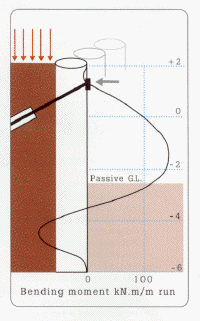
Horizontal and moment loads may be applied to the wall. Rotational spring restraints may be applied at any elevation in order to model the effect of floor slabs which are built into the wall. |
Data Input and Editing ( Top )
Data entry is menu
driven. Data values are checked for permissible ranges. A list of
data Errors and Warnings is displayed if unacceptable or
inappropriate data combinations are detected. Data can be checked
visually at any time during data entry or editing.
Units
Data may be entered in any consistent set of units e.g. (kN,m),
(lb,feet). All print-out from the program is automatically annotated
in the appropriate units.
Output from the Program ( Top )
Output from the program consists of the following:
Graphics ( Top )
Data and results are
displayed in graphical form either on the screen or in hard copy.
Graphical display of the data shows:
Results are displayed in the form of:
Hot Keys ( Top )
Special Hot Keys give instant access to Help facilities, Error reporting, Data plotting (during edit) and Summary output (during analysis).
Help ( Top )
Help is provided at two levels:- Press F1 at any time for context sensitive help on data entry or current activity. Press Alt+H at any time to use the Help Index. Subjects covered include advice on the selection of values of earth pressure coefficients and soil modulus.
Hardware Requirements ( Top )
WALLAP version 6 operates on all Windows systems. Program files occupy about 3Mb of disk space. Operation of the program requires about 10Mb of RAM.